Difficulty proving training completion during audits: an MSP evidence guide
Difficulty proving training completion during audits usually comes from weak evidence, not weak training. Here is the MSP fix.
DefendWise
DefendWise
TL;DR
Difficulty proving training completion during audits usually means the MSP has training activity, but not audit-ready records. Completion evidence needs to connect who was in scope, what they were assigned, what they completed, when they completed it, and which client or audit period the record belongs to. For MSPs, the fix is a repeatable evidence workflow: tenant-separated reports, clean exports, exception notes, retention rules, and a short cover note that says what the pack proves. That matters because frameworks such as ISO 27001, NIST guidance, CIS Control 14, and cyber insurance reviews all push clients toward documented, repeatable security awareness programs, not last-minute screenshot hunts.
Why training completion gets hard to prove
Most audit panic starts the same way.
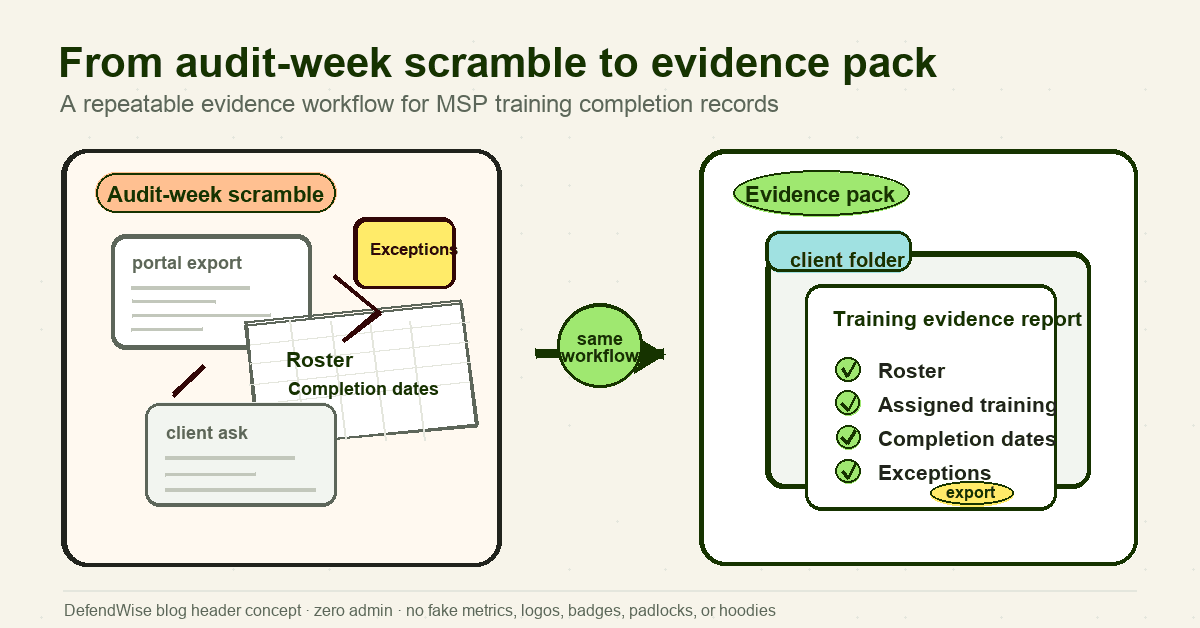
A client asks for proof that staff completed security awareness training. The MSP knows the training happened. Someone launched the campaign. Reminders went out. Most staff finished the module. A few people joined late, left the business, or sat outside the campaign scope.
Then the evidence request lands.
The training platform has one report. HR has a different user list. The cyber insurance questionnaire asks for training during the last 12 months. The ISO audit asks for awareness evidence under the ISMS scope. The QBR deck has percentages, but not names. The client wants a clean PDF. The auditor asks how exceptions were handled.
That is the real difficulty proving training completion during audits: the work is scattered across tools, tenants, dates, and assumptions.
Training completion is not enough. You need completion evidence that survives questions.
What auditors are really asking for
An auditor rarely wants a motivational story about security culture. They want evidence that matches the control, scope, and period they are testing.
For security awareness training, that usually means answering 6 questions:
| Audit question | Weak evidence | Better MSP evidence |
|---|---|---|
| Who was in scope? | "All users were trained" | Dated roster, tenant name, included groups, excluded users, and reason |
| What training was assigned? | Course title in a screenshot | Campaign/course name, topic, version, assignment date, and source system |
| Who completed it? | Completion percentage only | User-level completion export with completion date |
| What period does it cover? | Unclear dashboard view | Report period and export date shown in the pack |
| What about exceptions? | Missing users ignored | Exception log for new starters, leavers, leave, contractors, and reschedules |
| Can it be re-run? | One-off screenshot | Source report plus controlled evidence copy retained under the client record |
That last point matters. A screenshot might get someone through a quick questionnaire, but it is a poor operating model for an MSP managing many clients.
The evidence has to be repeatable.
The framework context, without overclaiming
Security awareness training evidence is not one universal compliance artifact. It supports different obligations in different ways.
ISO/IEC 27001 is the best-known information security management system standard. ISO describes it as a standard for establishing, implementing, maintaining, and continually improving an ISMS. That means awareness evidence sits inside a wider management system, not as a standalone badge.
ISO 27001 discussions often separate competence, awareness, and documented information. Clause 7.5 is about documented information. URM's practical explanation of ISO 27001 Clause 7.5 is useful because it frames evidence as controlled information that should be easy to locate, consistent with practice, versioned, and protected from unauthorized change.
NIST's current SP 800-50 Rev. 1 moves awareness and training toward a lifecycle approach. It says cybersecurity and privacy learning programs should encourage behavior change, support risk management, and include metrics and evaluation methods. That is a useful reminder for MSPs: the completion report is only one record in a bigger learning program.
CIS Control 14 is direct about the goal: establish and maintain a security awareness program to influence workforce behavior and reduce cybersecurity risks. Again, completion data helps, but the program has to be maintained.
Cyber insurance adds another pressure. Insurers and brokers increasingly ask clients to document controls, not just self-attest. SeedPod Cyber's 2026 insurance checklist says carriers want screenshots, exports, and evidence of tested controls, and lists security awareness training and phishing simulation evidence among the common requirements. Treat that as market guidance, not a universal insurer rule, because every policy and carrier form is different.
The safe takeaway: MSPs should not promise that one training report "proves compliance." It proves one thing: named people completed named training in a defined period, according to a defined source system. That proof is valuable when it is mapped correctly.
What a good training completion record contains
A useful training completion record should be boring. Boring is good in an audit.
It should include:
- Client or tenant name.
- Report period.
- Export date.
- Source system.
- User name or stable user identifier.
- Email address or employee ID, depending on the client's privacy rules.
- Department, group, or role where relevant.
- Assigned campaign or course.
- Assignment date.
- Completion status.
- Completion date.
- Due date.
- Exception reason, if incomplete or out of scope.
- Notes on new starters, leavers, contractors, and service accounts.
For MSPs, tenant separation is non-negotiable. One blended fleet report is a liability when the request is client-specific. It creates more work, more redaction risk, and more opportunities to send the wrong evidence to the wrong client.
If you manage training for many clients, build evidence around the client boundary first.
The MSP evidence-pack workflow
A good evidence pack does not need to be complicated. It needs to be consistent.
1. Define the scope before the campaign launches
Write down who is in scope for the client's training program.
That might be all active employees, all licensed Microsoft 365 users, all staff with access to client systems, or all users in specific groups. The key is to define it before the audit request. If the scope changes later, record the change.
MSPs get into trouble when the training platform says 94% complete, but nobody can explain the denominator.
2. Keep the source roster close to the training record
The roster is part of the evidence.
If the client uses Microsoft 365, HRIS, a PSA, or a manual spreadsheet as the source of truth, record which source created the learner list. If the list is manually cleaned, keep notes on what changed and why.
This is where onboarding and offboarding matter. A stale user list makes completion evidence look worse than it is. A missing new starter creates a real training gap. A disabled account still counted as active can drag down completion and confuse the audit story.
Related reading: how to onboard clients to a multi-tenant SAT platform.
3. Export evidence on a fixed cadence
Do not wait until an auditor asks.
Export client training evidence monthly, quarterly, or at the end of each campaign. Pick the cadence based on the client's risk, contract, and compliance cycle. Keep the export in a controlled client folder with a clear filename.
A simple naming convention works:
client-name_training-completion_2026-q2_exported-2026-06-30.pdf
The filename should answer the first 3 audit questions: who, what, and when.
4. Record exceptions while they are fresh
Incomplete users are not always failures.
Some joined after the assignment date. Some left before completion. Some are on leave. Some contractors sit outside the program. Some users need a reissued assignment because their email changed.
That context is much easier to capture during the campaign than 8 months later.
Create a short exception register for every evidence pack. Include the user, exception type, date, owner, and next action. If a client accepts an exception, record that approval.
5. Add a cover note
A cover note saves time because it tells the reviewer how to read the pack.
Use plain language:
- This pack covers Acme Co security awareness training for 1 January to 31 March 2026.
- The learner roster was sourced from Microsoft 365 active users on 2 January 2026.
- The assigned course was "Phishing and social engineering basics."
- The completion report was exported from the training platform on 31 March 2026.
- Exceptions are listed on page 4.
That note does not make weak evidence strong. It makes good evidence understandable.
6. Retain the pack under the client record
Evidence that only lives in a worker's downloads folder is not evidence. It is a future problem.
Keep the pack where the MSP can find it again. Use whatever controlled system the MSP already uses for client documentation. The key requirements are simple: client-specific location, consistent naming, access control, retention period, and version history where possible.
This connects back to ISO 27001 documented-information thinking: evidence should be controlled, findable, and consistent with actual practice.
Common mistakes that break audit evidence
Completion percentages without a roster
A 100% completion rate sounds good until the auditor asks "100% of whom?"
Always keep the roster and completion report together. The percentage is a summary, not the evidence.
Blended reports across many clients
Fleet reporting is useful for the MSP. It is risky as client evidence.
If the report contains multiple clients, someone has to filter, redact, and explain it. That is wasted admin time and a data-separation risk.
Related reading: multi-tenant SAT or single-tenant training for MSP operations.
Screenshots with no export date
Screenshots are easy to take and hard to trust.
If you use screenshots, include the visible tenant, date range, campaign name, export date, and source system. Better: attach the screenshot to an export that can be re-run.
Ignoring incomplete users
Incomplete users need an answer.
The answer might be "terminated before due date," "joined after campaign close," "manager approved extension," or "open remediation." What matters is that the answer exists.
Treating every framework the same
ISO 27001, NIST guidance, CIS Controls, SOC 2, cyber insurance, and client procurement reviews do not ask exactly the same question.
Do not reuse the same evidence pack blindly. Reuse the same source records, then map the cover note to the request.
What good looks like for MSPs
A strong MSP workflow has 5 features.
First, every client has tenant-separated training data. The MSP can produce a client-specific report without manual redaction.
Second, every report ties back to scope. The MSP can explain who was counted and who was not.
Third, evidence is generated before audit week. The MSP is not rebuilding 12 months of training history from inboxes.
Fourth, exceptions are visible. Incomplete users are tracked, not hidden.
Fifth, the evidence supports QBRs as well as audits. The same records can show coverage, completion, trends, and follow-up actions.
That is where the operational value sits. Audit readiness is not only about passing the audit. It is also about reducing the hours the MSP loses every time a client asks, "Can you send proof?"
Related reading: how to collect audit evidence for ISO 27001 awareness and how to prepare compliance evidence packs for ISO 27001 audits.
A simple evidence checklist
Use this before sending a training evidence pack to a client, auditor, broker, or internal reviewer.
| Check | Pass question |
|---|---|
| Scope | Does the pack say which users, groups, locations, or roles were included? |
| Client boundary | Is the evidence specific to one client or tenant? |
| Period | Does the pack show the reporting period and export date? |
| Assignment | Does it show what training was assigned and when? |
| Completion | Does it show user-level completion status and completion date? |
| Exceptions | Are incomplete, out-of-scope, new-starter, and leaver cases explained? |
| Source | Does the pack identify the source system? |
| Retention | Is the pack stored in the client's controlled documentation location? |
| Re-run path | Could the MSP reproduce the report if challenged? |
| Cover note | Does a non-technical reviewer understand what the pack proves? |
If a pack fails 2 or more of these checks, fix the record before you send it.
Where a flat-rate MSP SAT platform helps
A flat-rate MSP security awareness training platform helps when evidence work is currently trapped in per-client admin.
Defendwise is built for MSPs: flat $399/month pricing, unlimited users, unlimited client organisations, white-label delivery, multi-tenant management, AI-native training content, and client reporting. For audit evidence, the practical value is not a magic compliance claim. It is the ability to keep training and reporting aligned to the MSP operating model, so every client can get cleaner evidence without every extra user turning into another seat-cost decision.
If your MSP is still stitching together training completion proof by hand, start with the workflow above. Then look for SAT tooling that supports the workflow instead of adding another audit-week chore.
Start a free 7-day trial if you want to see what flat-fee MSP-first security awareness training looks like.
Frequently asked questions
Why is proving training completion during audits difficult?
It is difficult when training records live in screenshots, spreadsheets, email threads, and vendor portals that do not match the audit scope. Auditors usually need evidence that connects the right people, the right training, completion dates, exceptions, and the relevant period under review.
What evidence proves security awareness training completion?
Useful evidence usually includes a user roster, assigned training, completion status, completion date, course or campaign name, reporting period, tenant or client name, export date, and exception notes. For stronger evidence, keep the source report and a controlled evidence-pack copy.
Do auditors accept screenshots as training evidence?
Screenshots can support an evidence pack, but they are weak on their own because they are hard to filter, reconcile, version, and re-run. Exportable reports, dated rosters, and controlled records are safer.
How long should MSPs keep training completion records?
Retention depends on the client's contracts, compliance obligations, insurance requirements, and internal policy. The practical MSP rule is to define the retention period before the audit request arrives and keep evidence in a controlled client-specific location.
How do training records support ISO 27001 audits?
ISO 27001 focuses on an information security management system and documented information. Training evidence can help show that people received relevant awareness, education, or training, but the exact evidence should be mapped to the client's ISMS scope and auditor request.
What should MSPs include in a client training evidence pack?
Include scope, period, learner roster, assigned courses, completion report, exceptions, reminder history if available, campaign summary, export date, source system, and a short cover note explaining what the evidence proves.
Can Defendwise help MSPs prepare audit-ready training evidence?
Defendwise is built for MSPs that need flat-fee, multi-tenant, white-label security awareness training with reporting across client organisations. It can help reduce the admin drag of collecting client-ready training evidence without charging per seat.
Sources
- ISO, ISO/IEC 27001:2022 — Information security management systems
- NIST CSRC, SP 800-50 Rev. 1: Building a Cybersecurity and Privacy Learning Program
- NIST, NIST Cybersecurity Framework
- Center for Internet Security, CIS Critical Security Control 14: Security Awareness and Skills Training
- URM Consulting, ISO 27001 Clause 7.5: Documented Information Explained
- Konfirmity, ISO 27001 Training Requirements: A Practical Guide with Steps & Examples
- NCBI / PMC, Security Awareness Training for the Workforce: Moving Beyond “Check-the-Box” Compliance
- SeedPod Cyber, Cyber Coverage Requirements: The Minimum Controls Checklist
- Verizon Business, Data Breach Investigations Report
- NIST legacy PDF page, SP 800-50 archived publication notice