How to Prepare Compliance Evidence Packs for ISO 27001 Audits
How to prepare compliance evidence packs for ISO 27001 audits with scope, source records, exceptions, and reviewer-ready handoff.
DefendWise
DefendWise
TL;DR
How to prepare compliance evidence packs for ISO 27001 audits comes down to one discipline: do not hand over a folder dump.
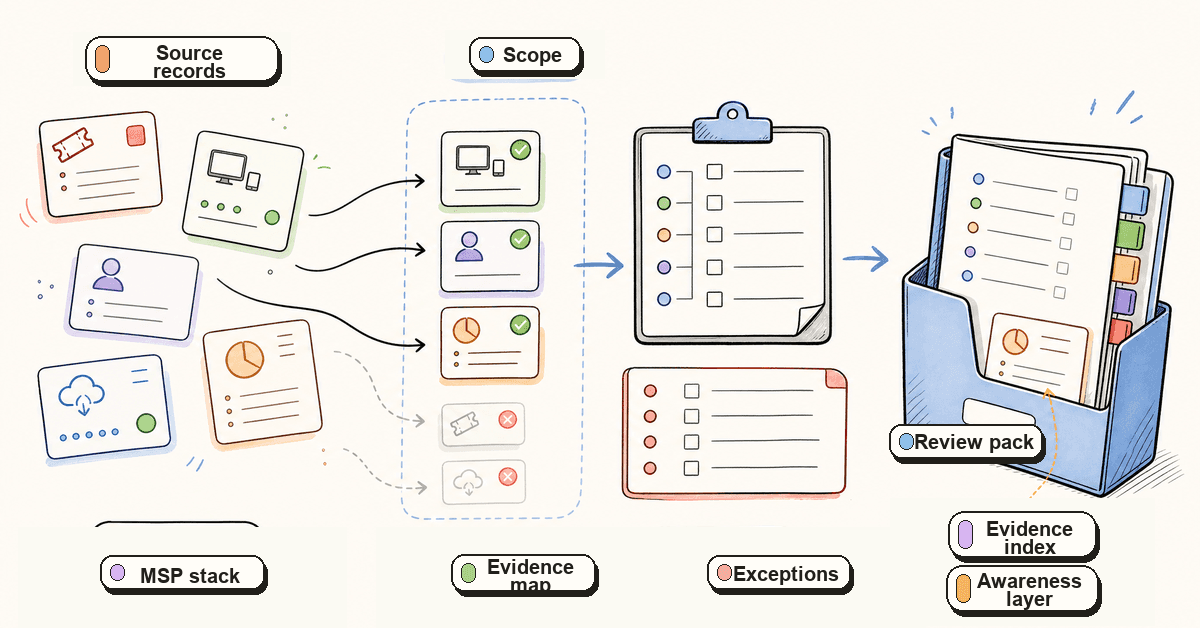
Build a pack that shows scope, source records, control mapping, owners, dates, exceptions, and a short explanation of what the evidence proves.
For MSPs, the pack also needs client separation. The wrong-client screenshot, stale user list, mystery CSV, or unsupported "yes" on awareness training can create avoidable audit friction.
Security awareness training is one part of the pack. It can support ISO 27001 Clause 7.3 and Annex A 6.3 evidence, but it does not prove the whole ISMS.
What is a compliance evidence pack for ISO 27001 audits?
A compliance evidence pack is a structured set of records prepared for a specific audit, assurance review, client request, or certification stage.
It is not every document the MSP can find.
It is the selected proof that answers a defined request.
The official ISO/IEC 27001:2022 page describes ISO 27001 as the best-known standard for information security management systems. It says the standard defines requirements an ISMS must meet and supports a risk-aware, continually improving approach to information security.
That matters because ISO 27001 audits are not only document checks.
The reviewer is looking for evidence that the ISMS exists, is scoped, is operated, and can be explained. Bridewell's guide to Stage 1 and Stage 2 ISO 27001 audits separates the documentation review from the implementation and effectiveness review. Stage 1 asks whether the ISMS documentation and readiness are in place. Stage 2 tests whether the controls and processes are operating.
That difference changes the pack.
A Stage 1 pack may lean on scope, policy, risk assessment, Statement of Applicability, process design, and mandatory documented information.
A Stage 2 pack needs operational proof: tickets, logs, review records, approvals, training records, incident history, access reviews, supplier reviews, internal audit actions, and evidence that exceptions are known rather than hidden.
For an MSP supporting clients, the evidence pack has another job.
It has to be safe to show.
That means no cross-client data, no mystery screenshots, no orphaned exports, and no claim that the MSP cannot defend.
Why ISO 27001 evidence packs fail for MSPs
Most weak evidence packs fail before the auditor opens the first file.
The work breaks because the pack has no operating model.
Evidence is scattered across too many systems
ISMS.online's MSP evidence-pack guide notes that MSP proof often lives across PSA tools, RMM and monitoring tools, backup platforms, identity systems, HR systems, contract repositories, email, chat, and file shares.
That is normal.
It is also dangerous when nobody owns the pack.
The audit request arrives, and the MSP starts hunting. One person exports a ticket list. Another pulls a report from a training portal. Someone else screenshots an access review. A vCISO adds a policy PDF. Nobody writes down which source is canonical.
The final pack may contain real proof, but it is hard to trust.
The pack does not match the audit request
The request "send ISO evidence" is too vague.
Evidence for Stage 1, Stage 2, surveillance, internal audit, client board reporting, cyber insurance, and a procurement questionnaire can overlap, but the handoff should not be identical.
Secureframe's ISO 27001 evidence collection list highlights a common problem: controls may not generate evidence in the right format, or evidence may be badly labelled and hard to find. That creates back-and-forth close to audit time.
The fix starts with intake.
Ask what the reviewer needs before exporting anything.
Nobody records exceptions plainly
An exception is not automatically a failure.
An unexplained exception is a problem.
If a user joined late, a contractor was out of scope, a control changed tool mid-period, a backup test was missed and rescheduled, or an awareness campaign had overdue users, the pack should say so.
Auditors and client stakeholders can handle plain facts better than polished gaps.
What an ISO 27001 evidence pack should include
The exact evidence depends on scope, certification stage, client maturity, and auditor request.
Still, most ISO 27001 evidence packs need these layers.
| Evidence layer | What it proves | Common records | MSP pack risk |
|---|---|---|---|
| Scope and request | What is being reviewed, by whom, and for what period | Audit request, scope note, tenant name, date range, included systems, exclusions | Wrong tenant, wrong period, or too much data |
| Governance and ISMS documents | The ISMS has a defined structure | ISMS scope, security policy, objectives, roles, Statement of Applicability, risk methodology | Old policy versions or unclear owner |
| Risk and treatment | Risks are identified and handled | Risk register, treatment plan, acceptance records, review notes | Controls shown without risk context |
| Control operation | Controls actually ran | Logs, tickets, screenshots, approvals, review records, alert records, test results | Screenshots without timestamps or source |
| People and awareness | People in scope know policy, duties, and consequences | Training assignments, completion reports, topic list, reminders, exceptions | Completion-only evidence with no scope or role context |
| Supplier and client evidence | Third parties and client dependencies are covered | Supplier reviews, contracts, SLAs, shared responsibility notes, client approvals | MSP/client ownership blurred |
| Internal audit and management review | The ISMS is checked and improved | Internal audit report, nonconformities, corrective actions, management review minutes | Findings without action status |
| Evidence index | The reviewer can navigate the pack | File index, owner, source system, control mapping, notes | Folder dump with no explanation |
Sprinto's guide to mandatory ISO 27001 documents points to the breadth of ISO documentation, including scope, information security policy and objectives, risk assessment and treatment methodology, Statement of Applicability, risk treatment plan, and related records.
The practical lesson for MSPs is simple.
Do not build the evidence pack around the tool that exported the prettiest PDF.
Build it around the reviewer's question.
Step-by-step: how to prepare compliance evidence packs for ISO 27001 audits
1. Capture the request and audit stage
Write down the request before collecting records.
Include:
- requester;
- audit type;
- due date;
- client or tenant;
- date range;
- ISO clauses or Annex A controls named;
- required format;
- reviewer expectation;
- final approver.
This short intake note prevents the MSP from building the wrong pack.
If the request is for Stage 1, documentation and readiness may matter most. If it is for Stage 2, the reviewer will want proof that controls operate. If it is for a client procurement team, the pack may need plain-English assurance more than certification-body detail.
2. Lock scope before exporting
Scope is the pack's boundary.
For MSPs, lock:
- client tenant;
- legal entity or business unit;
- systems and services in scope;
- users, groups, contractors, and locations;
- date range;
- evidence owner;
- exclusions;
- approved exception path.
Without scope, evidence becomes decorative.
A training completion report is weak if nobody knows which users were expected to complete the training. An access review is weak if it includes systems outside the audit boundary. A backup report is risky if it mixes client estates.
Multi-tenant SAT matters here because awareness evidence should start separated by client, not separated manually during audit week.
3. Map evidence to the request, not the other way around
Create a simple evidence map.
For each requested clause, control, or assurance question, record:
- evidence item;
- owner;
- source system;
- date range;
- file name;
- control or clause mapping;
- notes;
- known exceptions.
This is where the pack becomes reviewer-readable.
Elevate's Stage 2 evidence-mapping guidance describes the value of connecting controls to proof so audit preparation is less chaotic. The same principle applies even if the MSP is not running a full certification program for itself.
Evidence mapping prevents two bad outcomes.
First, the pack does not bury the reviewer in files.
Second, the MSP can spot missing evidence before the reviewer does.
4. Pull source records from the canonical system
Do not rely on copied screenshots if a source export exists.
Pull the record from the system that owns the truth:
- PSA for incidents, changes, approvals, and service requests;
- RMM or endpoint tooling for device and patch evidence;
- identity platform for access and joiner-mover-leaver records;
- backup platform for backup jobs and restore tests;
- training platform for awareness assignments, completions, topics, and reminders;
- ISMS tool or document store for policies, risks, SoA, internal audit, and management review;
- contract system for supplier and customer terms.
Name files consistently.
Include date, client, evidence type, and source where possible. The filename should help a tired reviewer at 4:30 pm.
5. Add exceptions before the pack is reviewed
Create an exception log.
Do not hide the rough edges.
For each exception, record:
- what is missing or late;
- why it happened;
- who owns it;
- whether the client accepted it;
- next action;
- target date;
- evidence of the follow-up.
This matters for awareness evidence.
If 7 users missed training because they joined 2 days before the audit period ended, say that. If a contractor group was out of scope, record the approval. If a campaign was reassigned after a role change, include the handoff note.
The goal is not perfection theatre.
The goal is honest, repeatable evidence.
6. QA the pack like a reviewer will read it
Before handoff, check:
- every file opens;
- every file belongs to the right client;
- every screenshot or export has a date or source trail;
- every claim has a matching record;
- every exception is listed;
- every control mapping is plain enough for a non-specialist client stakeholder;
- no vendor dashboard exposes another client;
- no file contains more data than the request needs.
This is where MSPs protect trust.
ScalePad's MSP audit-preparation guidance points to preparation, evidence, and clean reporting as ways for MSPs to face audits with less scramble. The trust point is broader than the audit itself: client confidence drops fast when evidence looks improvised.
7. Write a cover note
The cover note is not marketing copy.
It is a short guide to the pack.
Include:
- what the pack covers;
- what it does not cover;
- audit period;
- evidence sources;
- main contact;
- exception summary;
- how to read the index;
- any client-owned actions.
This is especially useful when the MSP supports the client but does not own every part of the ISMS.
The cover note should stop overclaiming.
Good line:
"This pack supports the awareness and managed-service evidence layers requested for the 2026 ISO 27001 surveillance review. It does not replace the client's ISMS risk register, internal audit record, or management review minutes."
Bad line:
"This pack proves ISO 27001 compliance."
Where security awareness evidence fits
Security awareness evidence belongs in the ISO 27001 pack, but it needs boundaries.
ISMS.online's guide to ISO 27001 Clause 7.3 Awareness frames awareness around personnel understanding the information security policy, their contribution to the ISMS, and consequences of nonconformity.
Its guide to Annex A 6.3 describes ongoing information security awareness, education, and training so people understand their security responsibilities. Advisera's Control 6.3 guide similarly describes awareness, education, and training evidence auditors may expect to see around competence, awareness, and control A.6.3.
NIST SP 800-50 Rev. 1, Building a Cybersecurity and Privacy Learning Program, adds a useful operating principle: learning should be managed as a life cycle program, with behaviour change, culture, metrics, and evaluation methods. CIS Control 14 also calls for a security awareness program that influences workforce behaviour and reduces cybersecurity risk.
For an MSP evidence pack, that means awareness evidence should show more than "training exists."
Include:
- who was in scope;
- what training was assigned;
- when it was assigned;
- what topics were covered;
- completion status;
- overdue status;
- reminder history;
- exception notes;
- report export date;
- tenant/client label;
- client-ready summary.
Automated reports help because awareness evidence should be repeatable. Compliance reporting helps when the MSP needs to connect training records to ISO 27001, NIST CSF, Essential Eight, QBR, or insurance conversations without rebuilding the same pack by hand.
But keep the claim tight.
Awareness evidence supports the people-and-training layer.
It does not prove access control, supplier management, risk treatment, incident response, backup, asset management, vulnerability management, internal audit, or management review.
What good evidence-pack preparation looks like
Good ISO 27001 evidence packs have 6 signals.
The pack has a single index
The reviewer can see every item, source, owner, date, and mapping in one place.
No guessing.
The pack is scoped
The client, tenant, period, and exclusions are clear.
If the evidence covers March to May, the pack says March to May. If contractors are excluded, the pack says who approved that.
Source records are traceable
The pack says where evidence came from.
A screenshot without source or date is weak. An export with source, date, tenant, and owner is stronger.
Exceptions are visible
The pack shows what is late, missing, out of scope, or remediated.
This is not a confession. It is evidence of control.
Client data is cleanly separated
No wrong-client screenshots. No shared tenant names. No accidental exposure.
This is where white-label delivery and multi-tenant workflows matter for MSPs. The client should see a managed service under the MSP's brand, not a messy vendor dump.
The pack gets easier next time
The first pack may take effort.
The second should be faster.
If every audit means rebuilding the same spreadsheet, the MSP has not solved the workflow. Automation should reduce repeat effort across reminders, reporting, onboarding, offboarding, and evidence collection.
Mistakes to avoid
Sending a folder instead of a pack
A folder says "good luck."
A pack says "here is the evidence, here is the scope, here is the mapping, and here are the exceptions."
That difference matters.
Treating awareness completion as the whole compliance answer
Training records are useful.
They are not the whole ISO 27001 story.
The pack should say awareness evidence supports Clause 7.3 and Annex A 6.3. It should not imply that training completion proves ISO 27001 compliance.
Mixing client evidence
This is the MSP trust killer.
If one screenshot exposes another client, the pack has failed even if the control evidence is good.
Ignoring stale users
User records decay quickly.
New starters, departed users, contractors, shared mailboxes, dormant accounts, and role changes all affect evidence quality.
Clean the roster before the final report pull.
Waiting until audit week
Audit week is for final QA, not first collection.
Secureframe's evidence-list guide warns about the last-minute scramble when evidence is missing, badly labelled, or not in the format requested. MSPs feel that pain harder because each audit request can cross multiple tools and client environments.
How Defendwise fits
Defendwise is not an ISO 27001 certification tool.
It should not be treated as the whole evidence pack.
It supports one important layer: MSP-delivered security awareness training and reporting.
For MSPs, that layer gets painful when training evidence is scattered by client, billed by seat, rebuilt by hand, or hard to show under the MSP's brand.
Defendwise is built as flat-rate, white-label, multi-tenant SAT for MSPs. The model is $399/month with unlimited users under fair use. That helps MSPs include awareness training across more clients without turning every user into a new cost discussion.
The practical evidence benefit is cleaner operation:
- client tenants stay separated;
- training and reporting can be packaged under the MSP's service;
- awareness evidence can support ISO 27001, QBR, and insurance conversations;
- reporting does not have to become a custom project every time a client asks.
Use it for the awareness layer.
Keep the wider ISO 27001 evidence pack honest.
FAQ
How do you prepare compliance evidence packs for ISO 27001 audits?
Start with the audit request, confirm scope and date range, map evidence to the relevant ISO 27001 clauses and Annex A controls, collect source records, document exceptions, QA the pack, and add a short cover note that explains what the evidence proves.
What should be included in an ISO 27001 evidence pack?
A useful ISO 27001 evidence pack usually includes scope, policies, risk records, control evidence, access records, incident and change records, supplier evidence, training and awareness records, internal audit records, management review evidence, exceptions, and an evidence index.
Is security awareness training enough for ISO 27001 compliance?
No. Security awareness training can support ISO 27001 Clause 7.3 and Annex A 6.3 evidence, but it does not replace the ISMS, risk assessment, control operation, internal audit, management review, or wider technical and governance evidence.
How should MSPs prepare ISO 27001 evidence for clients?
MSPs should keep each client tenant separate, confirm who owns each evidence source, avoid wrong-client exports, write plain-English cover notes, and keep repeatable pack templates for audit, QBR, insurance, and client-assurance requests.
What is the difference between collecting and preparing audit evidence?
Collection is the ongoing job of keeping policies, records, reports, logs, tickets, and training evidence. Preparation is the pre-handoff job of scoping, mapping, checking, explaining, and packaging that evidence for a specific reviewer.
How often should ISO 27001 evidence packs be refreshed?
Refresh evidence packs before each audit or high-stakes client request, and update the standing template after every audit finding, exception, scope change, tool change, or recurring evidence gap.
Can Defendwise help with ISO 27001 audit evidence packs?
Defendwise can support the awareness evidence layer by helping MSPs deliver flat-rate, white-label security awareness training across client tenants and produce cleaner client reporting. The MSP and client still own the broader ISO 27001 evidence pack.