Building auditor-ready reports for clients: an MSP guide
Building auditor-ready reports for clients starts with scoped evidence, clear exceptions, and repeatable MSP reporting workflows.
DefendWise
DefendWise
TL;DR
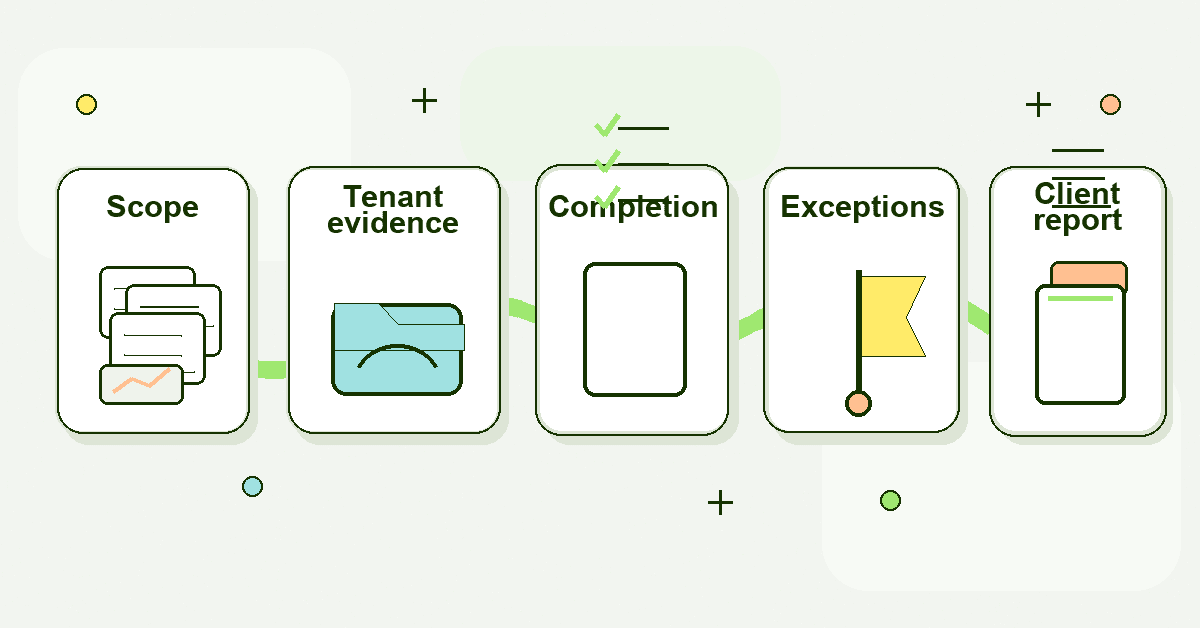
Building auditor-ready reports for clients is not a formatting job. It is a repeatable evidence workflow: define the request, lock the reporting period, separate each client tenant, map records to the right control, show exceptions, and hand the client a report they can actually use.
For MSPs, the risk is blended evidence. A good client report should show who was in scope, what training was assigned, who completed it, what remains open, which reminders were sent, and what the client needs to decide next. Security awareness evidence supports audit and insurance conversations, but it should never be presented as the whole control story.
What is an auditor-ready client report?
An auditor-ready client report is a client-specific pack of evidence that answers a control question without making the auditor chase context.
For security awareness training, that usually means the report can answer:
- who was in scope,
- which training or awareness activity was assigned,
- when it was assigned,
- who completed it,
- who did not,
- what exceptions exist,
- which reminders or escalations were sent,
- which framework or questionnaire item the evidence supports,
- and where the source records live.
That is different from a dashboard screenshot. A screenshot can show a status. A report explains the status, the scope, and the remaining risk.
NIST SP 800-50 Rev. 1 frames awareness and training as part of a broader cybersecurity and privacy learning program, with lifecycle management, metrics, evaluation, and continuous improvement. That matters because auditors rarely want proof that “a module exists.” They want evidence that the organisation runs a maintained program and can prove what happened during the period under review.
CIS Control 14 takes a similarly practical view. It calls for a maintained security awareness program and, in its assessment specification, looks at workforce lists, completion dates, and whether training is current. That is the shape MSP reports should follow: a defined population, dated activity, current status, and exceptions.
Why this matters for MSPs
MSPs sit in the middle of a messy evidence chain.
The client asks, “Can you send something for our auditor?” The auditor asks for specific evidence. The insurer asks for a questionnaire answer. The MSP has to translate platform data into a client-readable pack without overclaiming.
The common failure is treating every request as a custom scramble. Someone exports a CSV, adds a screenshot, pastes a sentence into an email, and hopes the auditor does not ask follow-up questions. That works until the client has more users, more tenants, more frameworks, and more deadlines.
For an MSP, auditor-ready reporting needs to be repeatable because the work repeats. ISO 27001 surveillance audits come back. Cyber insurance renewals come back. QBRs come back. New client onboarding brings another evidence baseline.
The business reason is simple: unmanaged evidence work burns margin. If every report needs manual reconstruction, security awareness training becomes another low-margin service chore. If the evidence pack is standardised, tenant-specific, and easy to review, the MSP can turn proof into part of the service.
What MSPs actually need in a client report
A useful report is not a dump of everything the platform knows. It is a controlled answer to a client question.
Use this structure as a baseline.
| Report section | What it should show | Why it matters |
|---|---|---|
| Scope | Client name, tenant, reporting period, user population, exclusions | Stops the report being mistaken for fleet-wide evidence |
| Control or request mapping | ISO 27001 awareness, NIST awareness/training, CIS Control 14, cyber insurance questionnaire item, or QBR objective | Shows what the evidence is being used for |
| Training assigned | Campaigns, topics, modules, dates, target groups | Proves what was expected of users |
| Completion evidence | Completion counts, dates, user-level roster, certificates if available | Shows who completed training and when |
| Exceptions | Incomplete users, new starters, leavers, out-of-scope accounts, access issues | Prevents false perfect-completion claims |
| Reminders and escalation | Reminder dates, manager prompts, MSP follow-up | Shows the control is operated after setup |
| Trend or metric view | Completion trend, reporting rate, repeat failures, high-risk roles where available | Makes the report useful outside audit week |
| Source records | Export names, platform report IDs, evidence owner, generation date | Lets the MSP reproduce the report if challenged |
| Client action | Decisions needed, gaps, next reporting date | Turns evidence into an operational next step |
The report should be boring in the right way. Same order. Same fields. Same caveats. Same evidence discipline. The client should not need to decode it every quarter.
Step-by-step: how to build auditor-ready reports for clients
1. Define the request before exporting anything
Start with the actual question. “Send training evidence” is too broad.
Ask what the evidence is for: ISO 27001, SOC 2, cyber insurance, an internal board pack, a QBR, or a customer security review. Then lock the reporting period and the population. A report for all active employees in Q2 is different from a report for privileged users during an ISO audit sample.
2. Separate the client tenant from the MSP fleet
Never hand over blended evidence. If an MSP manages 40 clients, a report that mixes tenants creates confidentiality risk and weakens the evidence.
The client report should carry only that client’s users, activity, exceptions, and branding. Multi-tenant systems make this easier, but the MSP still needs a review step before sending anything.
3. Match the evidence to the framework language
Do not claim more than the evidence proves.
For ISO 27001, awareness evidence may support the client’s awareness and training obligations, but it does not prove the whole ISMS is operating. For NIST SP 800-53, awareness and training is a control family, not a substitute for access control, incident response, or audit logging. For CIS Control 14, evidence should show program existence, training coverage, current completion dates, and role-specific depth where relevant.
This is where many client reports go wrong. They label a completion export as “ISO 27001 compliant.” A safer label is: “Security awareness training evidence supporting the client’s ISO 27001 awareness-control review.”
4. Build a user-level evidence roster
A summary chart is useful for executives. It is not enough for audit evidence.
Keep a user-level roster with names or approved identifiers, email domain, group or role, assigned training, completion status, completion date, and exception status. If the client has privacy requirements, use the identifier format they approve, but keep the source record reproducible.
For leavers and joiners, explain the rule. A user who joined yesterday should not be treated the same as a user who ignored training for 90 days. The report needs that distinction.
5. Add exceptions before the auditor finds them
Auditor-ready does not mean perfect. It means honest, scoped, and explainable.
List exceptions clearly:
- new starter not yet due,
- user offboarded during the period,
- duplicate or disabled account,
- client-approved exclusion,
- incomplete training requiring manager follow-up,
- inaccessible account or identity sync issue,
- campaign assigned after the reporting cut-off.
If the MSP hides exceptions, the report becomes fragile. If the report names them cleanly, the client can decide whether to remediate, accept, or document them.
6. Include evidence of operation, not only evidence of setup
A configured campaign is not the same as an operated control.
Include proof that the control was run: reminders sent, follow-up dates, manager escalations, policy acknowledgement, new-starter assignment, training refreshes, and report generation date. NIST SP 800-50 Rev. 1 emphasises lifecycle management and evaluation. The report should show that same lifecycle thinking.
7. Write a one-page cover note the client can forward
Most clients do not want to forward a raw CSV to an auditor or underwriter.
Create a short cover note with:
- report purpose,
- period covered,
- population covered,
- evidence sources,
- completion summary,
- known exceptions,
- limits of the report,
- and next action.
The limits matter. Say what the report does not prove. For example: “This pack covers security awareness training assignment and completion evidence. It does not validate MFA enforcement, backup testing, endpoint protection, or incident response maturity.” That sentence saves everyone from overclaiming.
What good looks like
A strong MSP client report has 5 traits.
First, it is tenant-specific. No other client data appears anywhere.
Second, it is dated. The reporting period, generation date, and evidence sources are visible.
Third, it has a user-level trail. Summaries help, but the roster proves scope.
Fourth, it maps evidence to a request without pretending to be the whole audit answer.
Fifth, it gives the client a decision. If 12 people are incomplete, the next step is not “see attached.” It is “approve escalation, extend the due date, or document the exception.”
For MSPs, the best reports also have an operating rhythm. Monthly or quarterly evidence packs make audit week less dramatic. QBRs become a natural place to review completion, exceptions, and next-quarter training topics.
Mistakes to avoid
Sending screenshots with no source trail
Screenshots are easy to fake, hard to reproduce, and often missing dates. If you include them, pair them with exports or report IDs.
Blending client tenants
A fleet dashboard might help the MSP manage operations. It does not belong in a client audit pack.
Treating completion as the whole control
Completion is one signal. A better report shows assignment scope, content, completion dates, reminders, exceptions, and refresh cadence.
Using framework labels too aggressively
Avoid “ISO 27001 report” if the evidence only covers awareness training. Use precise language: “ISO 27001 awareness evidence support.”
Waiting until audit week
Audit week reporting is expensive because every exception becomes urgent. Build the report rhythm into monthly or quarterly service delivery.
Framework mapping: awareness evidence without overclaiming
Security awareness reporting often supports more than one conversation, but each framework asks a different question.
NIST Cybersecurity Framework 2.0 includes awareness and training under the Protect function. NIST SP 800-50 Rev. 1 gives a deeper program model for learning, behavior change, metrics, and review. NIST SP 800-53 Rev. 5 includes awareness and training controls in the AT family.
CIS Control 14 is more operational. Its assessment language points toward evidence an MSP can actually collect: workforce list, completion dates, training currency, and content review cadence.
ISO 27001 evidence needs extra care because the standard is not only about training. Awareness evidence can support the client’s ISMS evidence pack, especially around awareness and training responsibilities, but the client’s auditor will also consider context, policies, scope, risk treatment, and other controls.
Cyber insurance questionnaires are different again. They often ask whether the client has employee security awareness training, phishing training, MFA, backups, endpoint protection, incident response, and other controls. The MSP should not use a training report to answer controls it does not cover.
A practical mapping looks like this:
| Request type | Training report can support | Training report should not claim |
|---|---|---|
| ISO 27001 awareness review | Training scope, completion, awareness topics, exceptions | Full ISO 27001 compliance |
| NIST CSF / NIST SP 800-53 | Awareness/training program evidence and review cadence | Full NIST implementation |
| CIS Control 14 | Program existence, completion dates, annual review, role-specific topics | All CIS controls |
| Cyber insurance questionnaire | Employee training evidence and phishing-awareness support | MFA, backups, EDR, logging, or incident response unless separately evidenced |
| QBR | Client risk conversation, gaps, trend, next-quarter action | Formal audit sign-off |
How a flat-rate MSP SAT platform helps
Auditor-ready reporting gets harder when every added user creates pricing friction or manual admin. MSPs need broad coverage, tenant separation, reminders, and client-ready reporting without turning every request into billable chaos.
Defendwise is built for MSPs with flat-fee pricing, unlimited users, multi-tenant management, white-label delivery, automated onboarding, reminders, and client reporting that can support compliance conversations when the evidence is scoped and reviewed. The soft win is simple: cover every user, keep the evidence separated by client, and make reporting part of the service rhythm instead of a favour at renewal time.
If you want to see the MSP operating model, start with the Defendwise blog, the multi-tenant SAT guide, the guide to how to collect audit evidence for ISO 27001 awareness, and the Defendwise home page.
Frequently asked questions
What does auditor-ready reporting mean for MSP clients?
It means the report is scoped to one client, tied to a real audit or questionnaire request, and backed by reproducible source records. The report should include dates, population, training activity, exceptions, and source references.
What should an MSP include in a security awareness evidence report?
Include training assignment, completion status, completion dates, user roster, topics covered, reminders, exceptions, and reporting period. If available, add role-specific training and trend data, but only when the source records support it.
Is a certificate enough to prove security awareness training?
A certificate helps, but it is usually not enough on its own. Auditors often need to understand who was in scope, when training occurred, whether the record covers the audit period, and what exceptions exist.
How often should client reports be generated?
Quarterly is a good operating cadence for managed clients. It keeps evidence current enough for QBRs, audit prep, and insurance renewals without turning every week into reporting theatre.
Can an MSP use one report template across all clients?
Yes, the template can be standard. The data must be client-specific. Reusing the structure protects quality; blending evidence creates risk.
Should the report include incomplete users?
Yes. Incomplete users are part of the evidence. A report that hides them is weaker than a report that explains the exception and the next action.
Does security awareness evidence prove cyber insurance readiness?
No. It supports one part of the answer. Cyber insurance questionnaires often cover MFA, backups, EDR, logging, incident response, and other controls that require their own evidence.
Where does Defendwise fit?
Defendwise helps MSPs run security awareness training under their own brand with flat-fee pricing, unlimited users, multi-tenant management, automated onboarding, reminders, and client reporting that can support compliance conversations when the evidence is scoped and reviewed. The report still needs MSP review before it is handed to a client or auditor.
Sources
- NIST SP 800-50 Rev. 1, Building a Cybersecurity and Privacy Learning Program: https://csrc.nist.gov/pubs/sp/800/50/r1/final
- NIST SP 800-50 Rev. 1 PDF: https://nvlpubs.nist.gov/nistpubs/SpecialPublications/NIST.SP.800-50r1.pdf
- NIST SP 800-53 Rev. 5, Security and Privacy Controls for Information Systems and Organizations: https://csrc.nist.gov/pubs/sp/800/53/r5/upd1/final
- NIST Cybersecurity Framework Protect function: https://www.nist.gov/cyberframework/protect
- CIS Control 14 assessment specification: https://cas.docs.cisecurity.org/en/latest/source/Controls14
- CISA, Recognize and Report Phishing: https://www.cisa.gov/secure-our-world/recognize-and-report-phishing
- CISA, Small and Medium-Sized Business Resources: https://www.cisa.gov/audiences/small-and-medium-businesses/secure-your-business/smb-resources
- CISA, Anti-Phishing Training Program Support: https://www.cisa.gov/resources-tools/services/anti-phishing-training-program-support
- FTC, Cybersecurity for Small Business: https://www.ftc.gov/business-guidance/small-businesses/cybersecurity
- Verizon DBIR resource hub: https://www.verizon.com/business/resources/reports/dbir
- ISMS.online, ISO 27001 Annex A 6.3 explanation: https://www.isms.online/iso-27001/annex-a-2022/6-3-information-security-awareness-education-training-2022
- DataGuard, ISO 27001 Clause 7.3 awareness: https://www.dataguard.com/iso-27001/clause-7-3-awareness
- Huntress, Cybersecurity insurance requirements: https://www.huntress.com/cybersecurity-insurance-guide/insurance-requirements